

Paradise Journal
Safe Diving in Bali: Health, Insurance & Flying
Safety rarely feels spectacular. That is precisely why it enables a relaxed dive holiday.
Before the first dive
The most important equipment is an honest answer.
Dive safety begins not with an oxygen kit or boat but with your current health, experience and condition that day. Medical screening is not paperwork for its own sake. It identifies when professional assessment is required.
Disclose illness, medication, surgery, pregnancy, colds, ear problems and long diving breaks honestly. A guide can adapt a dive but cannot provide medical clearance.
- Read the current PADI medical form early
- Confirm insurance cover in writing
- Store emergency contacts offline
- Plan flying and altitude after diving
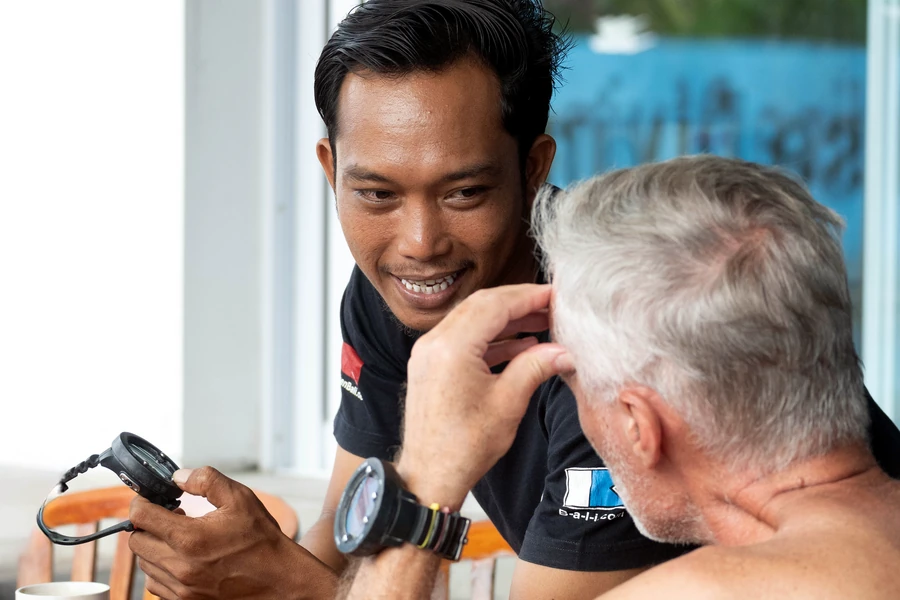
Health before ambition
When a day ashore is the better dive decision.
Fever, acute respiratory symptoms, blocked sinuses, ear pain, gastrointestinal illness, marked exhaustion or unexplained neurological symptoms are incompatible with diving. Medication that causes drowsiness or temporarily hides symptoms may increase risk.
Colds and equalisation
Swelling can prevent equalisation on descent or ascent. Decongestants can wear off. Pain is never forced through; the dive stops before injury occurs.
Hydration and heat
Tropical heat, boat wind, coffee, alcohol and diarrhoea can affect hydration. Regular water, shade and avoiding alcohol before dive days are simple, effective choices.
Seasickness
Report it early. Horizon, fresh air and light food help. Medication should be discussed before travel because drowsiness and other side effects matter underwater.
After surgery or new diagnosis
An old clearance is not automatically relevant after significant change. A diving-medicine doctor assesses exertion, healing, medication effects and the specific environment.
Decision aid
How do you feel today?
This does not replace medical advice but indicates the safe next step.
Briefing, buddy check, calm start.
You feel healthy, slept, ate and drank normally and have no new symptoms.
- Medical form current
- Inspect equipment
- State personal limits
- Monitor gas and depth
Ears and sinuses need clear passages.
Even a mild blockage can cause difficulty during descent or ascent. Do not self-medicate to force a dive.
- Postpone the dive
- Never force equalisation
- No decongestant shortcut
- Seek medical advice if needed
Recovery is part of safety.
Sleep loss, heat or dehydration affects judgement and comfort.
- Drink and eat
- Shade and sleep
- No alcohol
- Reassess honestly later
Do not wait, fly or dive again.
Pain, tingling, weakness, dizziness, loss of coordination, breathing difficulty or unusual skin changes are reported immediately.
- Stop diving
- Oxygen within training
- Contact DAN/medical help
- Preserve dive profiles
Flying after diving
Understanding DAN minimum intervals.
| Dive profile | DAN suggested minimum | Our planning |
|---|---|---|
| One no-decompression dive | 12 hours | Prefer a longer buffer and check itinerary |
| Multiple dives per day or multiple diving days | 18 hours | Protect a generous final no-dive day |
| Dive requiring decompression | Substantially longer than 18 hours | Individual medical and technical assessment |
| Possible DCS symptoms | Do not fly | Seek medical assessment immediately |
- Dive profile
- One no-decompression dive
- DAN suggested minimum
- 12 hours
- Our planning
- Prefer a longer buffer and check itinerary
- Dive profile
- Multiple dives per day or multiple diving days
- DAN suggested minimum
- 18 hours
- Our planning
- Protect a generous final no-dive day
- Dive profile
- Dive requiring decompression
- DAN suggested minimum
- Substantially longer than 18 hours
- Our planning
- Individual medical and technical assessment
- Dive profile
- Possible DCS symptoms
- DAN suggested minimum
- Do not fly
- Our planning
- Seek medical assessment immediately
Guidance applies to symptom-free divers; longer intervals reduce risk further. Computers and individual factors may be more conservative.
Insurance
“Travel insurance” does not automatically mean “diving insurance”.
Read the policy: are recreational scuba, your planned depth, chamber treatment, local evacuation, search and rescue and repatriation covered? Must a hotline authorise treatment? Does it cover medical costs only or also trip interruption?
Store policy number, hotline and documents offline. Your buddy should know where.
- Depth and certification limits
- Chamber and transport
- Search, rescue, repatriation
- Pre-existing conditions and exclusions

Sources & further reading
Continue with reliable information.
Current primary sources matter for safety, health, weather and entry. These links were checked on 31 August 2026.

People make the difference
Trust grows through many small moments.
An attentive briefing, carefully prepared equipment and a driver who knows the right route: the team behind the dive day makes relaxation possible.
- From the journal
- In depth
- Base
- Padang Bai
- Languages
- DE · EN
Safety FAQ
Not a diagnosis, but clear orientation
Can I dive while taking blood-pressure medication?
This requires individual medical assessment. Condition, stability, side effects and environment matter; general online clearance would be irresponsible.
Are 18 hours always enough before flying?
Eighteen hours is a DAN suggested minimum after multiple no-decompression dives or multiple days. Longer intervals reduce risk; decompression dives and individual factors need more conservative planning.
Where is the nearest chamber?
Emergency pathways and currently available facilities are coordinated through professional emergency and insurance services; static web listings can become outdated.
Your journey
Turn knowledge into your personal dive plan.
Send dates, experience, hotel area and wishes. We reply personally from Padang Bai.
- Personal no-obligation planning
- English or German
- Combine diving, transfers and accommodation